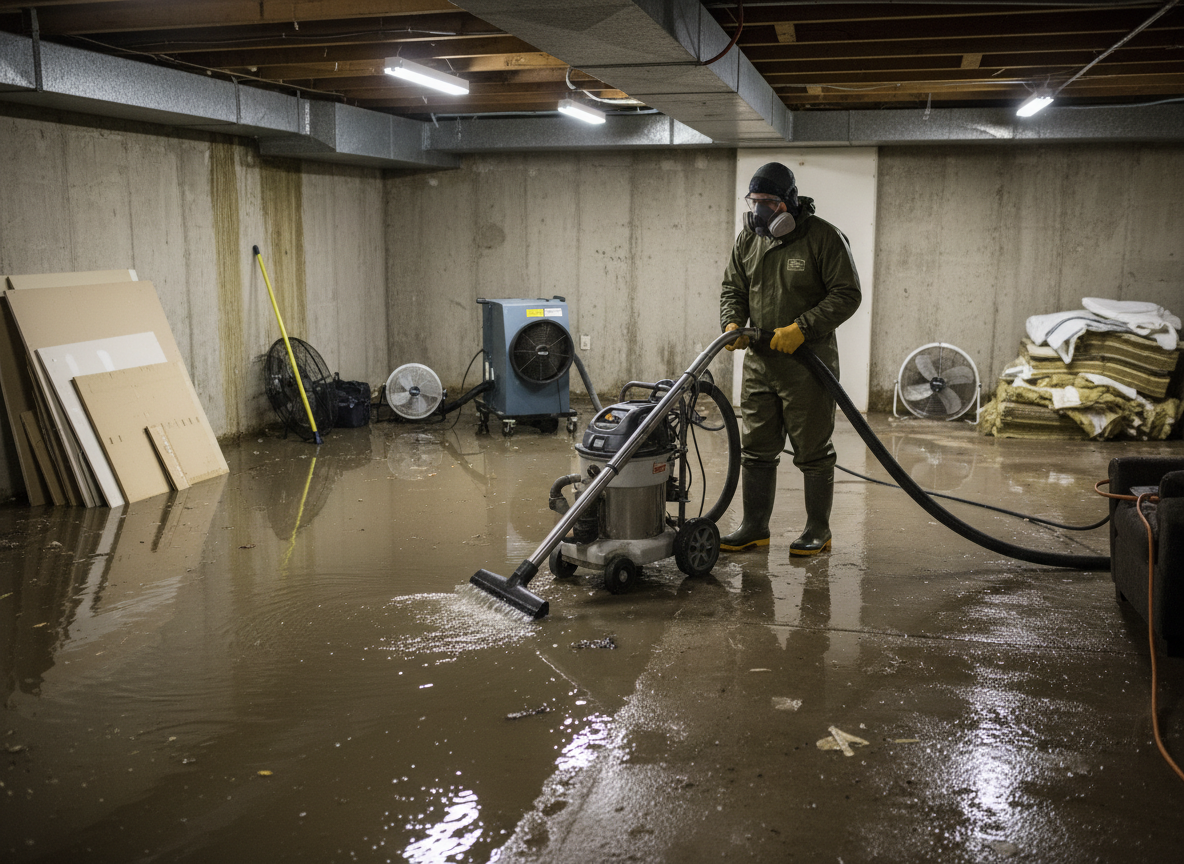
Tacoma's mild marine climate brings heavy winter rains that overwhelm older homes in the North End and Stadium District, where many properties still rely on original clay or cast-iron plumbing from the early 1900s. When a main line bursts or a roof leak lets water into finished basements, the first hours determine whether subfloors and wall cavities stay salvageable. Our crews arrive with truck-mounted extractors and moisture meters calibrated for the dense fir framing common here, pulling standing water before it migrates into neighboring units in multi-family buildings common on the Eastside.
Pierce County soil stays saturated for weeks after prolonged rain, so water that reaches crawl spaces under Hilltop or Proctor District homes often carries silt that clogs standard shop vacs. We use sediment traps and high-volume pumps rated for debris-laden water, then document hidden pockets behind lath-and-plaster walls that newer moisture readers miss. Homeowners in University Place and Federal Way frequently call after sump pump failures during the same storm cell that already saturated Tacoma; we coordinate with Lakewood crews to stage equipment before roads flood.
Edge cases include water that travels under the Chihuly Bridge of Glass area commercial slabs or into the older brick foundations near Union Station. In these situations we isolate affected zones with temporary dams rather than letting extraction fans push moisture into adjacent tenant spaces. Every job ends with a written moisture map so insurance adjusters see exactly which rooms crossed the 16 percent threshold that requires opening walls.
Technician insight
In Tacoma the thing that catches most people out with Emergency Water Removal is how long the clay-heavy soil around North End and Hilltop foundations stays wet after a single winter storm. Water that looks gone on the surface can wick back into joists for days if you don't pull it past the vapor barrier the first visit.
North End Basement After Main Line Break
A cast-iron main under a 1928 North End home cracked during a cold snap, sending water into the finished basement. We found standing water three inches deep plus saturation behind the original plaster on two walls. Extraction and containment kept the water from reaching the shared wall with the neighboring property; drying was handed off the same afternoon.
Emergency Water Removal Services We Offer
✓Standing Water Extraction
Truck-mounted pumps remove inches of water from basements and crawl spaces in North End and Hilltop homes before it reaches electrical panels or HVAC systems.
✓Sediment and Debris Removal
High-volume pumps with traps clear silt carried by Pierce County winter runoff that clogs standard equipment in older Tacoma properties.
✓Crawl Space Water Removal
Targeted extraction under homes in the West End and Eastside where saturated soil keeps water pooled against joists for weeks.
✓Multi-Unit Containment
Temporary barriers and negative air setups prevent water migration between units in Stadium District apartment buildings after shared plumbing failures.
✓Post-Storm Rapid Response
Same-day extraction for roofs and windows damaged during wet winters, focused on Downtown Tacoma and South End neighborhoods.
Emergency Water Removal Cost in Tacoma, WA
| Service | Typical Range | What Affects It |
|---|---|---|
| Single-room extraction | $250–$450 | Ground-floor rooms with clear access; increases with stairs or debris. |
| Basement or crawl space extraction | $400–$750 | Higher when silt or limited access requires specialized pumps. |
| Multi-unit containment setup | $300–$600 | Added barriers and negative air for shared walls in older buildings. |
| After-hours or weekend response | Add 25–40% | Calls outside Mon–Fri 8–6 or Sat 9–2. |
Ranges are typical for Tacoma, WA and confirmed with an exact written quote before any work starts.
How it works
- 1
Arrival And Safety Assessment
Technician evaluates electrical hazards and structural risks at the Tacoma address before any equipment enters.
- 2
Water Extraction
Truck-mounted and portable pumps pull standing water while sediment traps handle Pierce County silt.
- 3
Moisture Mapping
Infrared and pin meters locate hidden saturation in fir framing and behind plaster common in North End homes.
- 4
Containment And Documentation
Affected zones are isolated and a written report is prepared for insurance and homeowner review.
Pricing
Pricing varies by water volume, access difficulty, and whether sediment or multi-story extraction is required. We provide upfront ranges after the safety assessment.